
Now your mammogram can provide insight into your breast and heart health in
one exam.

The Onsite Women’s Health team implements Mammo with heart at Wake Internal Medicine in Raleigh, North Carolina, advancing breast and heart health through AI-enabled screening.

Bring added heart health value to every mammogram at your practice.

Onsite’s Mammo with heart program enables your patients’ routine screening mammograms to deliver insight into both breast and heart health—without adding time, appointments or workflow burden.

Breast Arterial Calcifications (BAC) are calcifications in the arteries of the breast and can indicate women at risk for cardiovascular disease. With Mammo with heart, powered by cmAngio® by CureMetrix®, advanced AI analyzes screening mammograms to both detect and identify the presence of BAC—providing additional clinical insight.

How Breast Arterial Calcification Impacts Your Patient’s Health
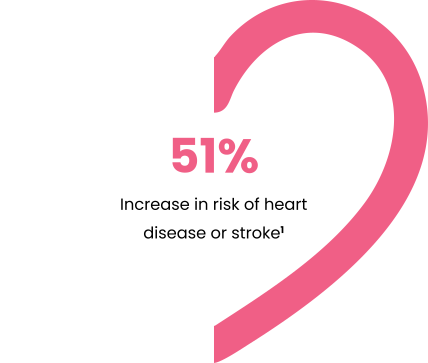
0 %
Increase in risk of heart disease or stroke¹

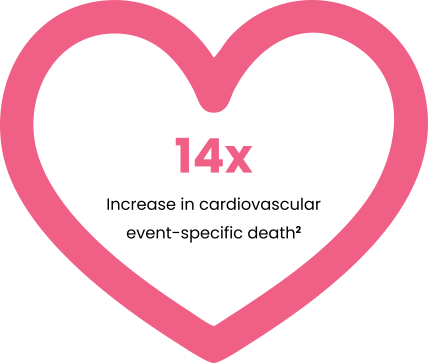
0 x
Increase in cardiovascular event-specific death²

0 %
of women aged 60–79 have arterial calcification³

Key facts about Mammo with heart

  • FDA-cleared, AI-based detection software for detecting and quantifying the presence of Breast Arterial Calcifications (BAC) on mammograms
  • Uses imaging data from a patient’s screening mammogram
  • BAC are linked to an increased risk of heart disease and stroke, making detection crucial for cardiovascular health
  • No additional effort required from the patient 
  • No additional radiation

Frequently Asked Questions

Mammo with heart is an enhancement to traditional screening mammography that uses FDA-cleared, AI-based software–cmAngio® by CureMetrix®–to both detect and identify the presence of Breast Arterial Calfications (BAC)—providing additional clinical insight.

Yes, the breast arterial calcification detection software that Onsite Women’s Health uses is FDA-cleared.

Breast Arterial Calcifications (BAC) are calcifications in the muscular wall (media) of the arteries of the breast. The calcium deposition leads to arterial stiffening when present. BAC are visible on screening mammography.

Based on extensive research and published literature, Breast Arterial Calcifications (BAC) are a cardiovascular risk factor and are associated with increased risk of coronary artery disease, heart failure, stroke, myocardial infarction (heart attack) and death. Patients identified with BAC should be evaluated for additional cardiovascular risk factors/cardiovascular health.

The cmAngio software “reads” the patient’s mammogram to determine the presence or absence of breast arterial calcifications. cmAngio is also able to assess the overall amount of BAC, and compare this amount to the patient’s age cohort to assess relative BAC burden for her age. One of Onsite’s radiologists reviews the results to check and confirm the findings.

No, with cmAngio, a screening mammogram serves as a two-for-one exam with no additional screening and no additional radiation.

We recommend your patient repeat the screening every year with her annual mammogram. Should your patient already be under the care of a cardiologist, or have known cardiovascular disease, however, BAC evaluation should be obtained as needed by her cardiologist.

Just as with screening mammography, all women may benefit from a Mammo with heart assessment regardless of their age, as long as they are able to undergo subsequent evaluation and treatment based on the assessment—in this case, an evaluation and treatment of her cardiovascular health.

cmAngio is not validated for patients with breast implants or any other devices in the breast/chest (such as pacemakers). These patients should not opt-in to Mammo with heart.

Mammo with heart is optional and is not yet covered by insurance. Therefore, any patient who opts in will pay out of pocket for the additional study. The current price will be set by the practice.

Contact us for more information.